

Thinking is one of the ways we find our way through life.
We look back at what happened, imagine what might happen next, compare possibilities, search for patterns, rehearse conversations, and try to understand ourselves and other people. We think before making decisions because decisions have consequences. We revisit mistakes because we want to learn from them. We anticipate problems because being prepared can protect us. Much of the time, this remarkable ability to step outside the present moment and examine our lives serves us well.
But thinking has an unusual limitation: it does not always recognize when its work is finished.
A question can remain open long after we have gathered all the information available to us. A conversation can continue in our minds long after the other person has left the room. We can examine a decision from one angle, then another, then return to the first—not because anything new has appeared, but because some part of us still believes that one more round of thinking might finally produce certainty.
Imagine walking through a forest and reaching a fork in the trail. Neither path is perfectly marked. You stop and look around. You study the ground, notice where the light falls through the trees, check your map, and think about where you are trying to go. Perhaps you walk a short distance down one trail to see where it leads, return, and compare it with the other.
That is useful. You are gathering information in order to move.
Now imagine remaining near that same fork for an hour. You walk twenty steps down one trail, become uncertain, return, inspect the other trail, return again, examine the same footprints, reconsider the same clues, and repeatedly circle the same group of trees. You are moving. You are working hard. You may even become exhausted.
But you are no longer getting anywhere.
That is what rumination can feel like.
The difficulty is that from inside the mind, circling can look remarkably similar to searching for a way forward.
Reflection and Rumination
Healthy reflection and rumination can begin with exactly the same question. After a difficult conversation, we might wonder why it affected us so strongly, whether we misunderstood something, whether there was something we could have handled differently, or what we would like to do if a similar situation happens again. None of those questions is inherently unhealthy. Reflection is one of the ways we make meaning from experience.
What distinguishes reflection from rumination is often less about what we are thinking about than about where the thinking takes us .
Reflection tends to move somewhere. It may be uncomfortable and it may take time, but eventually something changes. We understand a feeling more clearly. We recognize a pattern. We identify what is within our control. We decide to have a conversation, make a change, gather more information, apologize, set a boundary, or accept that there is no perfect answer. Sometimes reflection leads not to action but to acceptance: I wish this had happened differently, but I cannot change it now.
Rumination tends to return us to the beginning.
Why did I say that? What did they really mean? Why didn’t I notice sooner? What if I made the wrong decision? What if this happens again? How could I have allowed this to happen? What does this say about me?
The wording may change, but the underlying question remains open. Instead of producing clarity, the thinking often produces another reason to continue thinking.
This is why telling someone who struggles with overthinking to “just stop thinking about it” is rarely helpful. Rumination usually does not feel pointless from the inside. It feels necessary. The mind believes it is doing important work. It may even feel irresponsible to stop.
Human beings do not particularly like unfinished stories. When something important remains unresolved—a conflict, rejection, mistake, health concern, uncertain relationship, disappointing outcome, ambiguous message, or difficult decision—the mind naturally returns to it. There are good reasons for this. Remembering problems and anticipating threats can help us learn and prepare. A mind that never reconsidered mistakes or thought about future consequences would not serve us particularly well.
The difficulty begins when the mind treats uncertainty itself as a problem that sufficient thinking should be able to eliminate .
Suppose someone sends an important message and receives a brief response: “Okay, we’ll talk tomorrow.” There are many possible explanations. Perhaps everything is fine. Perhaps the person is upset. Perhaps they were busy. Perhaps tomorrow’s conversation will be difficult. The mind begins searching the available evidence. Why did they write “okay” instead of “sounds good”? Were they quieter earlier? Maybe the original message sounded wrong. Maybe another message would help. Maybe sending another message would make things worse.
For a while, this can feel like problem-solving. But eventually we encounter a simple limitation: the information needed to answer the question may not exist until tomorrow.
Thinking harder cannot manufacture missing information.
Yet uncertainty can be uncomfortable enough that the brain keeps trying. It returns to the same mental territory because stopping feels like leaving something unfinished, unprotected, or unresolved. And occasionally, after enough thought, we really do notice something useful. That intermittent reward makes the habit even more convincing. The mind learns that answers sometimes emerge from persistence, which makes it difficult to recognize the moment when persistence has stopped producing insight.
The result can be an enormous amount of mental effort directed toward obtaining certainty that the present moment simply cannot provide.
The Search for the Perfect Path
At the fork in the forest, uncertainty creates a tempting promise: If I examine everything carefully enough, perhaps I can choose a path with no possibility of regret.
The same promise appears throughout ordinary life. If I think long enough, perhaps I can be certain I am making the right decision. If I replay the conversation enough times, perhaps I can understand exactly what the other person thought. If I analyze a mistake thoroughly enough, perhaps I can guarantee that I will never repeat it. If I anticipate every possible outcome, perhaps nothing will catch me unprepared.
Sometimes analysis does help. But there are limits to what thought can accomplish. No amount of thinking can completely remove uncertainty from a relationship. We cannot know every consequence of a decision before living through it. We cannot reconstruct another person’s private thoughts with certainty. We cannot prepare ourselves so thoroughly that life loses its ability to surprise us.
When those limits become difficult to tolerate, thinking can gradually shift from trying to understand reality to trying to control uncertainty.
This helps explain why overthinking can feel so responsible. Stopping may feel careless. Making a decision may feel premature. Accepting “I don’t know” may feel like giving up. So we stay among the trees, studying the paths.
The paradox is that a person can become so committed to avoiding the wrong direction that they stop traveling at all.
Sometimes this process looks toward the future. We call much of that experience worry. What if I fail? What if the test result is bad? What if I lose the job? What if my child struggles? What if I say the wrong thing? Rumination more often turns backward or inward: Why did this happen? Why did I react that way? Why can’t I get over this? What does this say about me?
In real life, however, worry and rumination rarely respect such clean boundaries. A person may spend twenty minutes replaying yesterday’s conversation, decide that they probably made a mistake, and then spend the next hour imagining what will happen tomorrow. The mind travels from past to future and back again, looking for certainty in both directions.
This is one reason repetitive thinking can become closely intertwined with anxiety and depression. Anxiety can make uncertainty feel urgent and threatening, pulling attention toward possible dangers and future consequences. Depression can pull attention toward losses, perceived failures, self-criticism, and painful questions about why things have gone wrong. When these processes overlap, the forest can become particularly confusing. The mind revisits the past while simultaneously fearing the future.
The person may appear completely still from the outside while internally traveling miles.
There is another complication. Sometimes thinking itself becomes a form of avoidance.
We usually imagine avoidance as something visible: canceling the social event, postponing the appointment, avoiding the highway, refusing to make the phone call. But a person can also remain very busy mentally while postponing something emotionally difficult. Continued analysis can delay a decision, a conversation, a boundary, an application, an apology, the possibility of disappointment, or the acceptance that something simply cannot be changed.
Consider someone contemplating a career change. Research is sensible. They compare salaries, training requirements, job opportunities, commute times, and financial implications. The information helps them make a thoughtful choice. But eventually they have read the same information repeatedly. They compare the same options again. They ask another person for an opinion, and then another. They search for another article, another ranking, another discussion.
What began as preparation can gradually become protection from having to choose.
As long as the decision remains under analysis, it has not yet become real.
There is a difference between solving a problem and circling one .
One moves toward something.
The other creates the sensation of movement while keeping us near the same trees.
The Trail That Leads Back to Itself
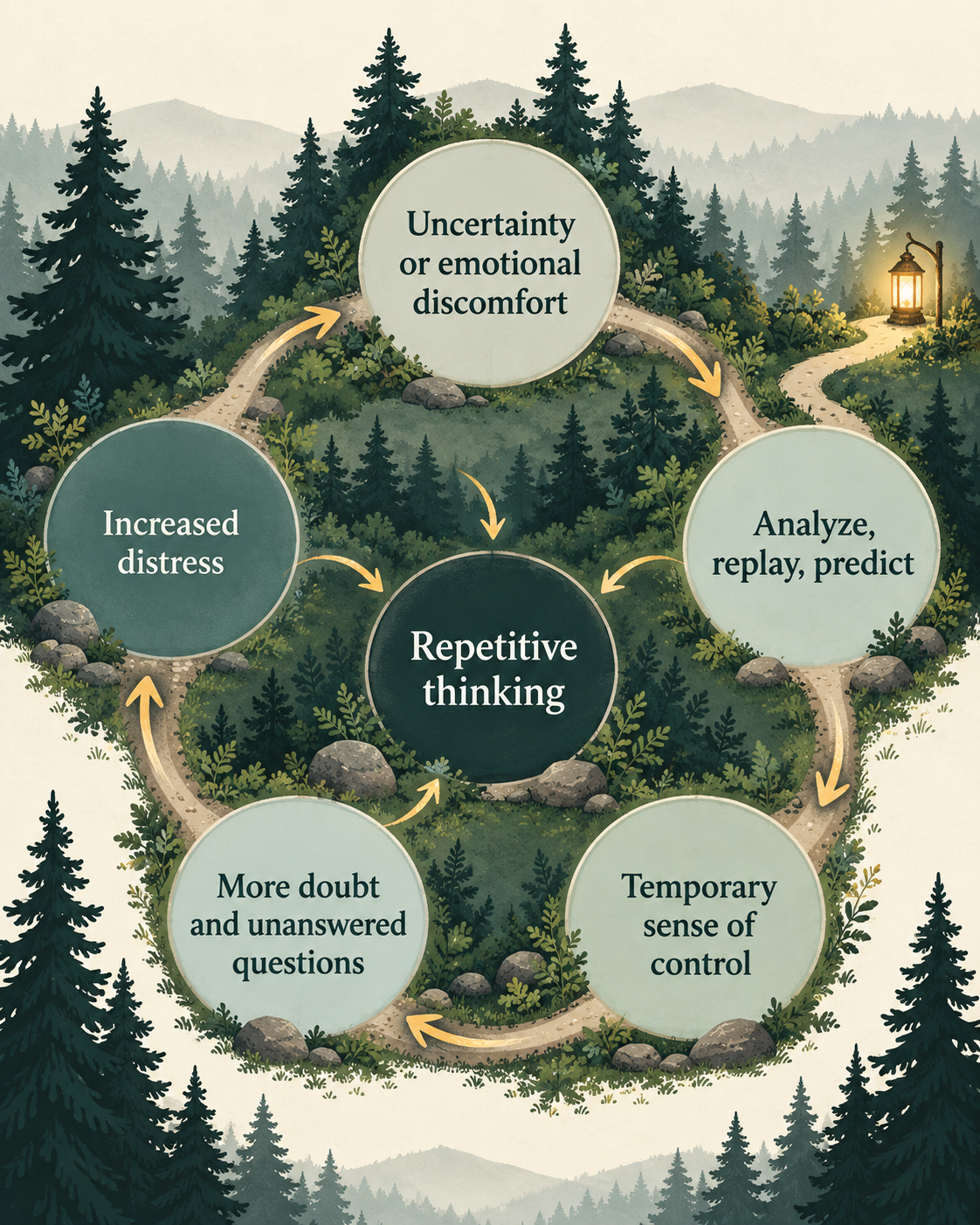
Rumination often sustains itself through a deceptively simple process. Something creates uncertainty or emotional discomfort. The mind responds by analyzing, replaying, predicting, or searching for an explanation. For a moment, this can create a sense of control: I am working on this. I am not ignoring it. But the thinking generates additional possibilities and unanswered questions. Doubt increases, distress returns, and the mind responds by thinking even more.
The trail curves back toward itself.
The temporary sense of control is important. Rumination does not necessarily make us feel better. In fact, it may make us feel worse almost immediately. Yet it can still provide something psychologically compelling: the sense that we are doing something about the problem. If we are thinking about it, perhaps we are not neglecting it. If we keep reviewing what happened, perhaps we can prevent it from happening again. If we remain mentally vigilant, perhaps we will be ready.
This can make stepping away from repetitive thinking feel strangely irresponsible.
But attention is not the same as action, and repetition is not necessarily preparation.
A useful question, then, is not simply, How long have I been thinking about this? Some problems deserve an afternoon of thought; others deserve months of reflection. A better question is whether the thinking is still changing anything.
Perhaps there is still information you can obtain. Perhaps you have not yet read the document, asked the question, spoken with the person, or considered an important consequence. In that case, thinking may be pointing toward a task.
But perhaps nothing new has appeared for a long time. You already know what happened. You know the choices available to you. You understand the risks as well as they can reasonably be understood. What remains is not missing information but the uncomfortable absence of certainty.
That distinction matters.
The absence of certainty does not necessarily mean the thinking is incomplete.
Sometimes it means certainty is unavailable.
The Lantern in the Forest
There is a particular demand hidden inside chronic overthinking:
I need to see farther before I can move.
It is an understandable wish. We feel safer when we can anticipate what is ahead. If the forest is unfamiliar, we may want a map detailed enough to show every turn, every obstacle, every place where the trail divides again.
Life rarely gives us one.
This is where the image of a lantern becomes useful.
A lantern is not a searchlight. It does not illuminate the entire forest. It cannot show what lies five miles ahead or prove that every turn will be easy. Its light reaches only a limited distance.
And yet that can be enough.
You can see the ground beneath your feet. You notice the next bend in the trail. You recognize a fallen branch. You take several steps, and the illuminated area moves with you.
The path becomes visible through movement.
This is fundamentally different from the promise rumination makes. Rumination often says: Understand the entire route first. Then you will be safe enough to proceed.
A more flexible response says: Understand what you reasonably can. Then take the next step and allow new information to appear as you move.
That is not recklessness. It does not mean ignoring consequences, abandoning planning, or making important decisions impulsively. It means recognizing that there is a point beyond which additional thought stops increasing wisdom and starts demanding an impossible guarantee.
Sometimes finding your way doesn’t require seeing the entire forest.
It requires seeing enough of the path to take the next step.
That next step does not always mean making a decision. Sometimes it means gathering information. Sometimes it means having the conversation you have been rehearsing. Sometimes it means writing down what you know and what remains unknown. Sometimes it means deciding that a problem deserves twenty minutes of attention tomorrow rather than three hours tonight.
Sometimes the next step is acceptance.
Grief cannot always be solved. Another person’s opinion cannot be controlled. The past cannot be reconstructed until we find a version that no longer hurts. Two choices can both contain advantages and losses. A relationship can matter deeply and still contain uncertainty. We can make a thoughtful decision and later wish that something had happened differently.
And sometimes the next step is simply returning attention to the life happening around us.
Dinner still needs to be made. Someone we love is telling us a story. There is work to finish, a dog waiting at the door, music playing somewhere in the house, rain against the window, a book beside the bed.
Rumination can convince us that we are not permitted to return to ordinary life until the problem has been resolved.
But unresolved things can coexist with living.
We can care deeply about something and put it down for the evening. We can have unanswered questions and still sleep. We can feel uncertain and still participate in our lives. We can return to a problem when there is something useful to do.
The Trail Appears as You Walk
There is another reason the forest metaphor matters.
A trail seen from a distance is not the same trail experienced while walking it.
Choices generate information.
The conversation you were afraid to begin changes once the other person responds. The class you were unsure about becomes clearer after the first few weeks. The new job is no longer hypothetical after you begin it. A boundary teaches you something when you see how another person responds. A difficult task becomes different after the first attempt.
Thinking cannot provide all of that information in advance.
Some knowledge is available only through participation.
This is one of the quieter costs of rumination. While trying to think our way into certainty before moving, we can postpone the very experiences that would give us the information we are seeking.
The next step does not have to settle the entire question. It only needs to be a step.
And if it turns out not to be the right direction, that becomes information too.
We adjust. We turn. We learn the terrain.
A path does not have to be perfectly straight to lead somewhere.
None of this is an argument against thinking deeply. There are experiences that deserve reflection. We should learn from mistakes. Important choices deserve attention. Relationships benefit from self-awareness. Painful experiences may need to be understood gradually rather than pushed away.
The goal is not to become less thoughtful.
It is to develop a more flexible relationship with thought.
Reflection can ask a question and remain open to an answer. Rumination often asks the same question after the available answers have already been given. Reflection can eventually say, I did the best I could with what I understood then. Rumination replies, Yes, but let’s examine it one more time.
Reflection can recognize, I need more information.
Rumination may insist, Then keep thinking until the missing information somehow appears.
Reflection can lead toward action, acceptance, understanding, or intentional waiting.
Rumination often leads back to itself.
Learning to notice that difference does not mean we will never become caught in repetitive thinking again. Familiar mental paths can be remarkably easy to enter, especially during periods of stress, anxiety, loss, conflict, or low mood.
The aim is not perfection.
It is recognition.
I’ve been past these trees before.
And that recognition itself can create a choice.
You Don’t Need the Whole Map
Perhaps there is something you have been trying to solve for a long time.
A conversation you continue replaying. A decision that keeps reopening after you thought you had made it. A question about yourself for which every answer seems to create another question. A future you are trying to predict before allowing yourself to enter it.
The instinct may be to ask, What else do I need to think about?
There may be another question worth asking:
What would enough look like?
Enough information to make a reasonable decision. Enough understanding to recognize what happened. Enough preparation to begin. Enough certainty to take one responsible step—not absolute certainty, but the kind human beings actually get to have.
Perhaps part of the problem is yours to solve and another part is outside your control. Perhaps you have reached the edge of what analysis can tell you. Perhaps the next piece of information is waiting not inside another hour of thought, but somewhere farther down the trail.
There will always be parts of the forest we cannot see from where we stand.
That is not necessarily evidence that we are lost.
Sometimes we need to stop circling long enough to notice that there is already a trail beneath our feet.
The lantern does not promise to illuminate everything.
It offers something more modest, and often more useful:
enough light for the next step.
When insight needs support
When knowing isn’t enough
Recognizing a pattern of rumination does not necessarily make it easy to leave. Repetitive thinking can become especially persistent when it is connected with anxiety, depression, self-criticism, difficult relationships, major transitions, grief, or unresolved experiences.
Therapy can provide a place to examine not only what you are thinking about, but what the thinking is trying to accomplish. It can help distinguish useful reflection from repetitive mental loops, explore what makes uncertainty difficult to tolerate, and develop ways of responding that allow thought to become a tool again rather than a place to remain stuck.
The goal is not to stop caring, stop reflecting, or force thoughts away. It is to recognize when thinking is helping you navigate—and when it has begun leading you around the same trees.


Anxiety & Uncertainty
When the Wind Changes
Why Anxiety Makes Us Avoid What Matters
An educational reflection on anxiety, avoidance, uncertainty, and taking small meaningful steps toward what matters.
Explore anxiety & avoidance
Self-Compassion
What Compassion Actually Means
Care without minimizing what hurts
An educational reflection on self-compassion, responsibility, and setting down the unnecessary weight of self-judgment.
Explore self-compassion